Man-to-Man or Zone Defence: Two Ways to Guard Space
Man-to-man or zone defence in basketball assigns attention differently. Learn what each protects, where it can be strained, and which situations favor it.
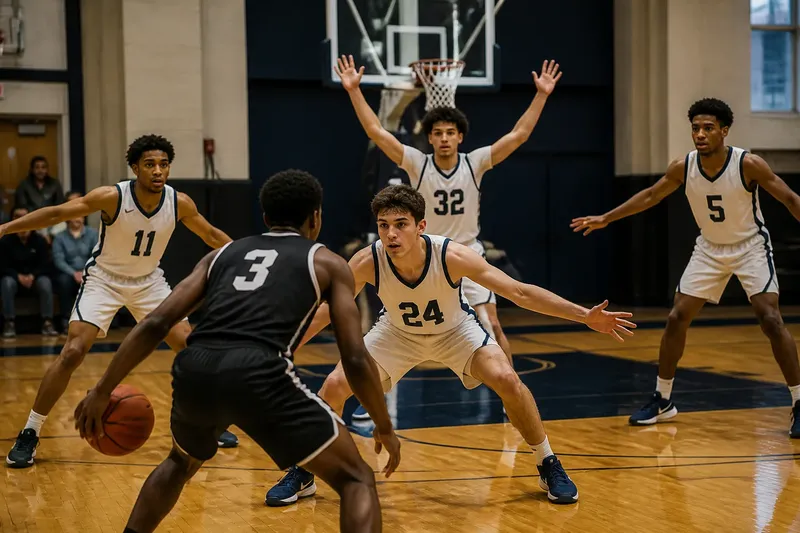
Man-to-man or zone defence in basketball comes down to what a defender is responsible for: a particular opponent or a portion of the floor. That choice changes where five players look, how they help one another, and which shots an offense is invited to take. To read the matchup, start with the defensive assignment—not with the assumption that one system is automatically tougher.
What does each defense ask a player to guard?
In man-to-man defence, each defender has a primary offensive player to track. The assignment can change after a screen, a switch, or a rotation, but the basic reference remains a person. If that player cuts across the lane, the defender usually follows or hands the cutter to a teammate according to the team’s coverage.
In zone defence, each defender is responsible for an area and for the opponents who enter it. A player moving from one part of the court to another may pass from one defender’s attention to another’s. The defenders still have to identify threats and communicate; a zone is not five players standing in fixed patches of floor.
Both approaches allocate attention. Man-to-man directs it toward known opponents, then asks teammates to help when a defender is beaten or pulled away. Zone places defenders to protect useful spaces, then asks them to recognize who is entering those spaces and where the ball is headed. Neither removes the need to make decisions.
When does man-to-man fit better?
Choose man-to-man when the defensive plan depends on disrupting particular players or keeping close track of movement away from the ball. A strong perimeter scorer, a frequent cutter, or a skilled passer may be easier to account for when a defender can stay attached and teammates know who is responsible. This can also make it clearer where pressure should come from.
Man-to-man fits when defenders can stay in front of their assignments without abandoning the rest of the floor too often. It gives a team a straightforward way to challenge a ball handler, contest a cut, and follow a matchup through changing positions. If the offense uses screens, the defense must decide whether to switch, trail, show help, or use another agreed coverage.
Its cost is the space created when individual matchups are pulled apart. A defender who chases a cutter may open a lane; a teammate who helps on a drive may leave a shooter. Once one player is beaten, nearby defenders have to help, then recover to their own opponents. The system’s visible assignment can make that chain easier to describe, but it does not make the chain effortless.
When can zone protect the more important space?
Choose zone when the defense wants to crowd a particular area, reduce clean paths to the basket, or make the offense work around a set of defenders rather than attack one matchup repeatedly. A compact alignment can place several players near the lane and invite the ball to travel around the perimeter. That invitation is a tactical choice, not a promise that every outside shot will be missed.
Zone can also make sense when defenders are struggling to contain several individual matchups at once, or when the offense’s movement is easier to track by area than by player. Because assignments shift with the ball and with cutters, the defense can preserve attention near a threatened space without asking one defender to follow an opponent everywhere.
The trade-off is that a zone can concede particular openings if its players are late to shift, communicate, or close out. Passing the ball quickly from side to side can force defenders to cover ground. An offense may also place players in gaps between defenders or send someone to the short corner, where a receiver can catch the ball near the baseline between the lane and the corner. Those spots test whether the zone has clear responsibility for the next pass.
Which situation points to which choice?
- A dangerous individual scorer: Favor man-to-man if the team has a defender who can stay connected and the plan calls for limiting that player’s touches or preferred routes. A zone may still help by crowding the scorer’s area, but responsibility for a receiver moving between zones can be less direct.
- Repeated drives through the middle: Consider zone if placing defenders near the lane is the priority. Man-to-man can also protect the middle with help rotations, but that may leave teammates responsible for recovering to shooters.
- Several cutters and frequent position changes: Favor man-to-man when defenders can communicate through switches or handoffs and the team needs clear ownership of each moving player. A zone can absorb movement too, but cutters must not slip through gaps while defenders assume someone else has them.
- An offense relying on perimeter passing: Either defense can respond, depending on the defenders’ ability to close out and the offense’s shooting threats. A zone may make passing lanes look crowded; man-to-man may apply closer pressure to receivers. Watch whether the ball moves the defense out of shape.
- One defender repeatedly beaten off the dribble: A zone can reduce how often that player is isolated in open space, provided teammates are ready to cover the lane. Man-to-man remains an option if the defense changes the matchup or supplies timely help without giving up an easy pass.
- A team needing clear individual accountability: Man-to-man usually makes the first assignment easier to identify. The coaching question then becomes whether help and recovery responsibilities are equally clear.
Imagine a team facing an opponent whose best ball handler keeps turning the corner into the lane, while other players wait around the perimeter. The defense switches from man-to-man to a compact zone, with defenders positioned to meet the drive earlier. The expected observable result is that the ball handler encounters more bodies near the basket and must pass outward sooner; the defense then has to move together to contest the next shot.
What changes when the offense moves the ball?
In man-to-man, the ball’s movement does not usually change who a defender is guarding, though it may trigger a switch or help rotation. A defender can shade toward the ball while keeping sight of an assignment, then recover when the pass comes. The challenge is balancing those two responsibilities: help too little and a drive may reach the rim; help too long and the assigned player may receive an open shot.
In zone, the ball often determines how the whole defense shifts. Defenders slide toward the ball side, protect the lane, and stay alert to players moving behind or between them. The weak side—the side away from the ball—cannot simply disappear from attention. A skip pass across the court can punish a slow shift, while a pass into the middle can force several defenders to decide who takes the receiver.
For a viewer, follow the next responsibility rather than trying to memorize every position. After a pass, ask who closes out, who protects the rim, and who has the player cutting behind the defense. If the answer is unclear, the offense may have found a gap. If two defenders go to the same threat, another opponent is likely to be free.
How can you tell which defense is working?
Do not judge solely by whether the offense scores on a possession. A contested shot can go in, and an open shot can miss. Instead, watch what the defense repeatedly allows: direct drives, uncontested shots, easy passes into the lane, or offensive rebounds after defenders lose track of nearby opponents.
Against man-to-man, look for whether defenders remain connected through cuts and screens, and whether help arrives without leaving a simple outlet pass. Against zone, look for coordinated shifts, a defender meeting the ball near the edge of the protected area, and someone taking responsibility for the short corner or the rebound. In either system, an open shot is more informative when you can see how the opening formed.
Rebounding provides another useful clue. Man-to-man defenders often begin with opponents already identified, but must still make contact and secure the ball rather than turn to watch it. Zone defenders must locate an opponent as the shot goes up, since an offensive player may be entering from a different part of the floor. The alignment changes the first assignment; it does not collect the rebound by itself.
Man-to-man or zone defence: what should you watch for?
Does a zone mean defenders never guard a person?
No. Zone defenders still close out on shooters, contest drives, and make contact on rebounds. Their responsibility begins with an area, but a player entering that area can become their immediate assignment.
Can a team change defenses during a game?
Yes. A team can use one defense as its usual approach and switch to another to address a particular matchup or change the offense’s rhythm. The change is most useful when players know the new responsibilities, especially for cutters and passes across the court.
Is man-to-man always more aggressive?
No. Man-to-man can be played with pressure or with more space, depending on where defenders position themselves and how they handle help. A zone can pressure the ball too, though its shape and rotations differ.
Which defense is harder to score against?
That depends on the players, the offensive choices, and how well the defenders communicate. Read the specific matchup: man-to-man concentrates responsibility on opponents, while zone concentrates responsibility on spaces and the threats moving through them.
What is the simplest way to read the choice?
Man-to-man is the clearer fit when the priority is tracking particular players and the defense can manage the resulting help-and-recovery work. Zone is the clearer fit when protecting a space—often the lane—matters more than staying attached to each opponent across the floor. Those are starting points, not rigid rules.
When watching man-to-man or zone defence, notice what the defense is willing to concede and what it is trying to take away. Then trace the possession: who drew attention, who shifted to help, and who became free as a result. The answer often explains the tactical choice better than the label on the alignment.