The Volleyball Setter’s Job Starts Before the Set
The volleyball setter’s job is to turn a pass into a playable attack by reading the ball, coordinating with hitters, and choosing a set the team can use.
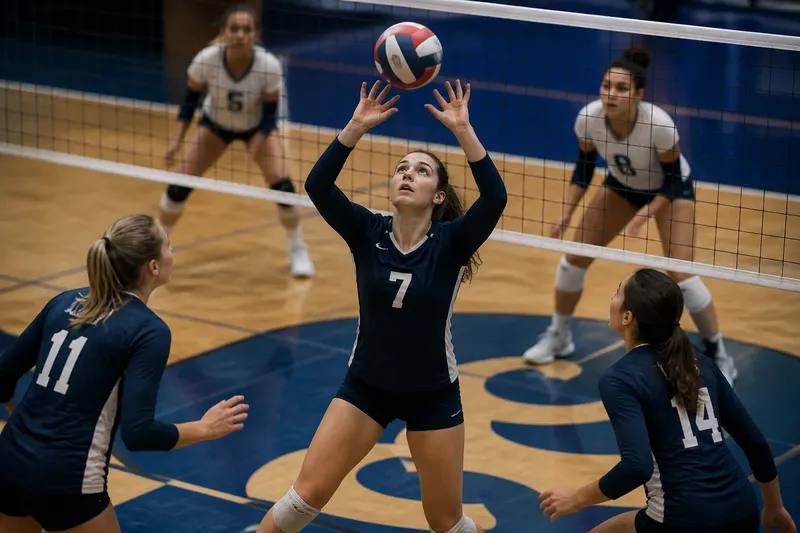
The volleyball setter’s job is to turn the second contact into a playable attack, and that decision starts as soon as the first contact leaves a teammate’s arms. The setter reads where the ball is going, moves to meet it, and chooses a delivery that matches the pass and an attacker’s readiness.
In a typical three-contact sequence, one player receives the serve or keeps an attack in play, the setter directs the second contact, and a teammate attacks on the third. The setter coordinates that sequence, but the pass, hitter movement, and team communication all shape what is possible.
What does the setter read before the ball arrives?
The setter tracks the ball’s height, direction, and speed, then moves toward a position from which a controlled set is possible. Reading early matters: it leaves more time to organize an attacker instead of making the choice while still chasing the ball.
The pass is a starting point, not a script. A ball near the net and close to the setter can leave several options open. A pass that drifts toward a sideline or away from the net can limit those options, making a higher, more forgiving set sensible.
Hitters provide another set of cues. The setter watches whether an attacker has begun an approach, has room to swing, and can reach the intended ball in balance. A quick attack also requires coordinated timing between setter and hitter; speed alone does not make it a workable play.
How does the setter choose a playable set?
The useful choice is the one the team can execute from the position it is actually in. A promising matchup does not help if the setter cannot deliver the ball there or the hitter is late. The setter weighs the pass, the hitter’s movement, and the space available, then commits early enough for the attacker to adjust.
Imagine a pass drifting several steps off the net and pulling the setter toward the sideline. The middle hitter is still moving into position, while the outside hitter has begun a balanced approach. The setter sends a higher ball toward the outside; the resulting tradeoff is a more readable attack, but one the hitter can reach without forcing a last-second change of direction.
Communication keeps that choice legible. A hitter’s call or agreed signal can show readiness, while the setter’s call can help the attacker commit to a route. Neither replaces reading the ball, but both reduce the chance that setter and hitter prepare for different plays.
What cues should guide the setter’s decision?
Several observations help distinguish an available option from a theoretical one. Use them together rather than treating any single cue as decisive.
- Pass location: If the ball is close to the net and within controlled reach, consider the planned set; if it pulls the setter away, choose a higher, simpler delivery or keep the ball playable.
- Pass control: If the ball arrives with a predictable arc, use the time to coordinate a hitter; if it is dropping or veering, prioritize a reachable set over a fast combination.
- Hitter approach: If an attacker is moving in balance toward the intended area, send the planned ball; if the hitter is late or off balance, choose a more forgiving target that is ready.
- Available space: If the hitter has room to swing in a useful direction, use that lane; if a blocker is already set to close it, direct the ball toward a more open route the hitter can reach.
- Setter’s position: If the setter can face the court and control the ball, consider the available attacking options; if still chasing, favor a simpler delivery the hitter can read.
- Communication: If a clear call or agreed signal confirms the hitter is ready, use that option when the ball permits; if signals conflict or none arrives, choose the clearest available target rather than waiting.
These decisions do not promise a clean attack. They make the next action easier for the hitter to read, which is useful enough in a sport where the ball has no interest in anyone’s preferred plan.
What changes when the setter takes the first contact?
If the setter receives the serve or an opponent’s attack, another teammate has to take the second contact. Teams prepare for this possibility because one player cannot receive and set the same sequence. The substitute setter may deliver a less familiar ball, so hitters should watch who has possession and adapt their approaches to the available set.
Even when another player takes the first ball, the setter’s movement matters. Arriving in control can let the setter face the court and see the hitters. If the pass forces a chase, the set may still be possible, but the setter may have fewer options and less time to coordinate.
What questions come up about the setter’s second contact?
Can the setter attack on the second contact?
Yes. If the ball is on the setter’s side and the action complies with the rules, the setter can send it over instead of setting a teammate. That choice may catch defenders expecting a set, but it still has to fit the ball and the situation.
Why might the setter set from behind the attack line?
The setter may move back to reach a pass or make room to deliver the next ball. From that position, the setter’s options differ, so the team should respond to where the ball and setter are rather than assume every set comes from near the net.
What happens if the second contact is too awkward to set?
A player can send the ball over to keep the rally alive when a useful set is not available. The team should then prepare for the opponent’s next attack instead of relying on a third-contact swing.
Does every second contact have to reach a hitter?
No. A return over the net can be the sensible option when the team is out of position or the ball cannot be controlled for an attack. The aim is to make a playable decision, not to force the planned sequence after it has stopped being practical.
How can you recognize a sound setter decision?
Look for whether the setter’s movement matches the pass, whether the hitter is ready for the delivery, and whether the ball gives that hitter room to act. The volleyball setter’s job is not to make every attack surprising; it is to make the next contact clear enough for the team to play it.
One last useful cue is the hitter’s adjustment after the release. If the attacker can continue an approach without a sudden detour, the set matched the available movement. If the hitter has to stop or change direction sharply, the setter and attacker may need to clarify their timing or target before the next rally.