Why Tennis Uses a Tiebreak to Settle a Long Set
Why tennis uses a tiebreak: learn how it settles a close set and what to watch in the serve order, return patterns, and event-specific rules.
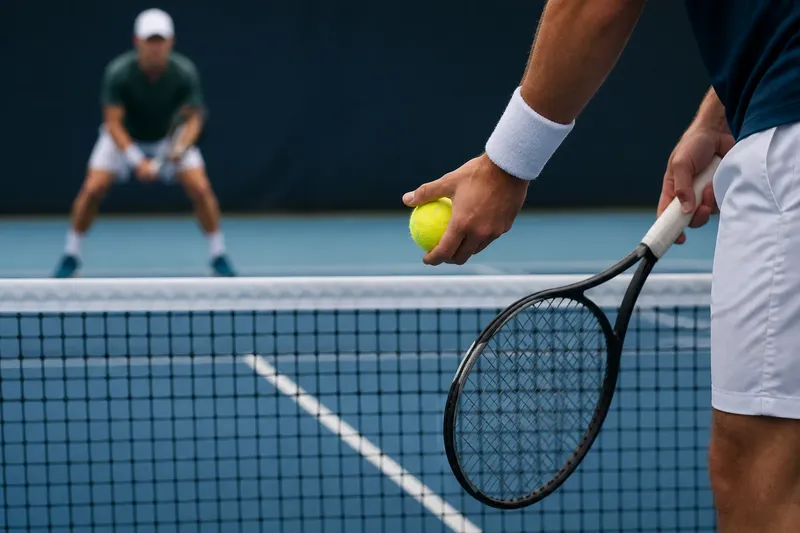
Tennis uses a tiebreak to settle a close set without letting ordinary games continue indefinitely. Why tennis uses a tiebreak becomes clearer when you watch the transition: the set’s familiar game structure gives way to a point-by-point finish, and each player must adjust to a different rhythm.
The tiebreak is part of the set, not a bonus contest after it. Its winner takes the set, while the preceding games still explain how the players arrived at that finish.
What problem does a tiebreak solve?
In a set that requires a two-game lead, players who keep holding serve can remain level at the closing threshold. Without a tiebreak, they continue playing ordinary games until one builds the required margin. The tiebreak provides another way to settle that stalemate.
It changes the method of deciding the set, not the value of the points already played. Instead of adding more games, the players contest a defined ending in which individual points determine who takes the set.
Why do some sets use a tiebreak instead of continuing?
Allowing a set to continue can produce a gradual breakthrough, especially if one player eventually finds a way to return serve effectively. But when both players keep holding, the same contest can repeat without producing a new separation.
A tiebreak makes the finish bounded and changes the immediate task. That is the tradeoff: spectators lose the possibility of watching the set continue through ordinary games, while the players face a concentrated contest in which each point counts toward the set result.
How does a tiebreak change the rhythm?
In ordinary games, service turns come one game at a time. A tiebreak has a different serving order, so a player does not simply serve a whole game and then wait through the opponent’s game. Check the event’s rules for the applicable procedure; details can vary.
The scoring unit also changes. A point won on return has an immediate place in the tiebreak rather than serving mainly as a chance to set up a later break. A strong serve can still shape the point, but it does not settle a game on its own.
Imagine a tiebreak begins with the server repeatedly aiming first serves toward the returner’s backhand. The returner stands closer on the next service point and blocks the ball deep down the middle. If the server has to play a defensive second shot, the returner has changed the point’s opening; if the server attacks the next ball, the returner must defend instead. The observable result is a different first exchange, not a prediction about who will win the tiebreak.
What should you watch during a tiebreak?
Use the score to understand the stakes, then track specific choices. These checks connect what you see to a useful decision about the pattern:
- Observe the next server. Check the displayed score and the event’s serving procedure; if the next turn is clear, follow that player’s service points, and if it is not, consult the official match display rather than guessing from the previous game.
- Observe the return position. If the returner moves forward and gets the ball back, watch whether the server changes pace or placement; if the returner is late or repeatedly misses, watch for a deeper starting position or a safer return.
- Observe the first shot after the serve. If the server reaches a comfortable first volley or groundstroke, note the serve-and-first-shot pattern; if the returner takes control with depth, look for the server to reset the rally rather than force an immediate winner.
- Observe serve direction. If the server repeats a location and the returner begins anticipating it, watch for a change of direction; if the variation produces missed serves or weak contact, the server may return to the more reliable target.
- Observe the response after an error. If a player returns to a familiar routine and target, note that the plan has stayed steady; if the player changes risk or placement, watch whether the opponent adapts or benefits from the new pattern.
- Observe the competition’s format. If official event information specifies a standard tiebreak procedure, follow that rule; if it lists a special deciding-set format, use that instead of assuming every set ends the same way.
These checks help separate a visible adjustment from a guess about confidence. A returner moving forward is an observable choice; deciding that the player is nervous requires more than a camera angle.
What does a tiebreak reveal about a player’s choices?
Serving matters, but it is only one part of the contest. The returner can affect the opening shot through position, depth, and willingness to attack. Players also have to respond to the changing service turns and choose whether to repeat a familiar pattern or alter it.
Say a player reaches a tiebreak after repeatedly serving wide on the deuce side, and the opponent begins moving early toward that corner. The server tries a serve up the middle; the returner blocks it back, and the server plays a controlled groundstroke rather than going for a winner. The next point begins with the returner holding a more central position, so the server has created uncertainty without immediately abandoning the rally. The tradeoff is visible: a less predictable serve may change the return, but it can also give up the comfort of a well-practiced location.
How do tennis tiebreak rules differ by event?
Do not assume every tournament uses the same ending in every set. A tiebreak may begin at the set’s closing threshold, while the deciding set can follow a different procedure. The event’s published rules or official match display can clarify which format applies.
Players generally need to reach the event’s specified point target and win by the required margin. The target and any special deciding-set rule depend on the competition, so reaching a familiar number does not always mean the tiebreak is over.
What do spectators ask about tennis tiebreaks?
Does a tiebreak count as part of the set?
Yes. The tiebreak settles the set that has reached the relevant threshold, and its winner takes that set. It is not a separate match after the set has ended.
Does losing a tiebreak mean losing the set?
Yes, when the event’s format uses that tiebreak to decide the set. The player who loses it loses the set, just as a player would lose after the decisive ordinary game in a format without a tiebreak.
Why can a deciding set look different?
Events can use different procedures for deciding sets, including different rules about whether and when a tiebreak is played. Check the competition’s published rules rather than assuming another tournament’s format applies.
Is a tiebreak only about serving?
No. Serving can shape a point, but return position, depth, and shot choice also affect how it unfolds. A spectator can track those choices without trying to infer a player’s private state of mind.
What is the tradeoff in using a tiebreak?
A tiebreak replaces the possibility of more ordinary games with a compact way to decide a close set. It preserves a contest between the players, but shifts attention from game-by-game service holds to point-level decisions and a changing service order.
When asking why tennis uses a tiebreak, keep the event’s rule in view and follow the next serve, the return position, and the first shot after contact. Those details show not just that the set is being settled, but how each player is trying to shape its ending.