The Offside Line Starts with the Pass
Understand football offside by checking the instant a teammate plays the ball, then comparing the attacker’s position with the ball and second-last opponent.
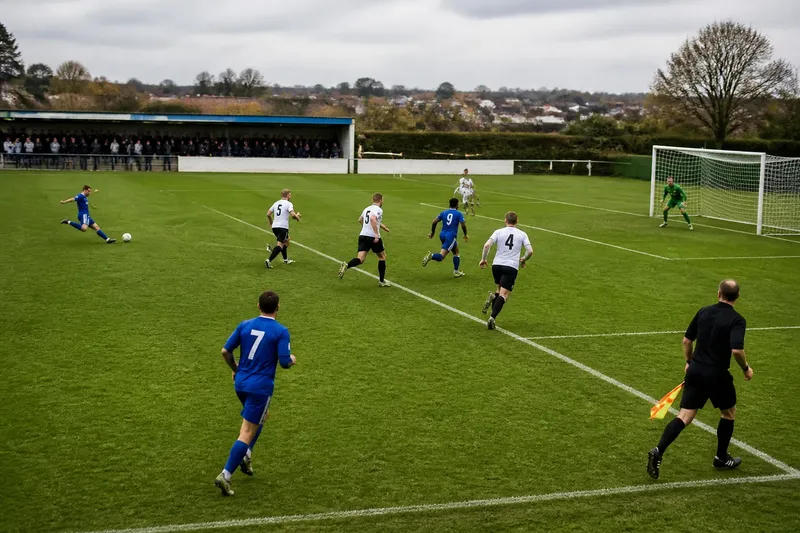
Football offside is judged at the instant a teammate plays or touches the ball, not when the pass reaches the receiver. To read a close call, first hold onto that instant; then compare the attacker with the ball and the second-last opponent.
There are two separate questions: was the attacker in an offside position at that moment, and did the attacker later commit an offside offence? Standing beyond the defensive line does not answer both questions. The position, the type of play, and what the attacker does next all matter.
Which touch sets the offside position?
Start with the teammate who plays the ball. The reference moment is that teammate’s contact with it—not the receiver’s run, the ball passing a defender, or the receiver’s first touch.
On an ordinary ground pass, the moment is usually clear: it is the kick. In a crowded exchange, watch for the actual contact that sends or redirects the ball. If another teammate then deliberately plays it, assess the attacker’s position again at that later touch. Each relevant teammate’s touch can create a new position check.
Imagine a midfielder preparing a pass while a forward runs behind the defense. If the forward is level with the second-last opponent when the midfielder kicks the ball, the forward is not in an offside position at that instant. Running beyond the opponent before receiving the pass does not change the earlier comparison.
How do you find the offside line?
At the teammate’s touch, compare the attacker with the halfway line, the ball, and the second-last opponent. The attacker is in an offside position only when all the relevant conditions apply: they are in the opponents’ half, nearer the opponents’ goal line than the ball, and nearer that goal line than the second-last opponent.
“Nearer the goal line” describes where the player is on the field, not which way they are moving. An attacker running back toward their own goal can still be in an offside position if, at the relevant touch, they are beyond both the ball and the second-last opponent toward the opponents’ goal. A forward sprint alone does not make a player offside.
The second-last opponent is not automatically the goalkeeper. Usually the goalkeeper is one of the two opponents nearest the goal line, but not always. Look at the positions of all opponents at the instant of the pass and identify the second one from the goal line; do not assume the goalkeeper marks the line.
- Check the halfway line: If the attacker is in their own half or level with the halfway line, they are not in an offside position; if they are in the opponents’ half, continue to the other checks.
- Check the ball: If the attacker is level with or behind the ball, they are not in an offside position; if they are nearer the opponents’ goal line than the ball, continue comparing.
- Count opponents: If fewer than two opponents are nearer their goal line than the attacker, the attacker may be beyond the second-last opponent; if two or more are nearer, the attacker is not beyond that line.
- Compare legal playing parts: If only an arm or hand is beyond the relevant line, do not count it; if the head, body, or feet are beyond it, use those parts in the comparison.
- Check whether the players are level: If the attacker is level with the second-last opponent, they are not in an offside position; if the attacker is nearer the opponents’ goal line, continue to the involvement question.
These checks concern position, not whether the attacker is standing still, running, or trying to get involved. A player may look well beyond the defense and still be onside if the ball is ahead of them or the second-last opponent is closer to goal.
When does that position become an offence?
Being in an offside position is not an offence by itself. The player must then become involved in active play. The main routes are playing or touching the ball, interfering with an opponent, or gaining an advantage from a rebound or deliberate save.
The simplest case is an attacker who was in an offside position when a teammate played the ball and then plays or touches it. An attacker may also be penalized without touching the ball if their actions interfere with an opponent’s ability to play or challenge for it.
For instance, suppose a forward is in an offside position as a teammate passes toward another attacker. If the forward stays clear and does not affect an opponent, the position alone does not make it an offence. If the forward blocks the goalkeeper’s view or challenges a defender for the ball, the referee may judge that the forward interfered with an opponent.
An attacker can also gain an advantage by playing a ball that rebounds from an opponent, the goal frame, or a deliberate save, provided the attacker was in an offside position when the teammate played the ball. A defender’s deliberate play can change the assessment, but not every touch does. A deliberate save is treated differently from an attempt to play the ball; a deflection, or an unsuccessful attempt to control it, does not automatically reset the situation.
How can you follow a close call in real time?
Keep the decision in order. Identify the relevant touch, place the attacker at that instant, compare the ball and second-last opponent, and only then look for involvement.
- Spot the passer’s contact. Watch the teammate who plays the ball until you can identify the touch that starts the assessment.
- Hold the attacker’s position in mind. Use where the attacker is at that contact, not where they are when the ball arrives.
- Compare the reference points. Check the halfway line, the ball, and the second-last opponent, using the attacker’s head, body, or feet rather than the hands and arms.
- Check for involvement. Ask whether the attacker played the ball, interfered with an opponent, or gained an advantage from a rebound or deliberate save.
- Keep position and offence separate. If the attacker was in an offside position but did not become involved, that position alone is not a reason to stop play.
Say a winger sends the ball across the field while a striker runs toward goal. At the kick, the striker is level with the second-last opponent; by the time the ball arrives, the defender is behind. The striker was not in an offside position at the kick, so the later gap does not make the run offside.
A close call can look different from different seats because the passer and receiver may be far apart. A replay can help show their positions, but the question stays the same: where were they when the teammate played the ball?
Which close-call details change the decision?
Can a player be offside directly from a throw-in?
No. A player cannot be penalized for an offside position when receiving the ball directly from a throw-in. The same exception applies to a direct goal kick or corner kick; if a teammate touches the ball before it reaches the player, assess the later touch instead.
Does every defender’s touch reset the assessment?
No. A defender’s deliberate play can mean the attacker is judged from that new play rather than the teammate’s earlier pass, but a deliberate save is treated differently. A deflection or an unsuccessful attempt to control the ball does not automatically reset the assessment, so the nature of the defender’s action matters.
Do hands count when comparing positions?
No. The hands and arms of players, including goalkeepers, do not count when determining an offside position. Use the head, body, or feet—the parts with which a player may legally play the ball.
Can an attacker be beyond the defender but behind the ball?
Yes, but that player is not in an offside position at the teammate’s touch. If the attacker is level with or behind the ball, being nearer the opponents’ goal line than the second-last opponent does not change the result.
What should you check when the flag goes up?
Read the decision as a sequence rather than judging the receiver’s location at the end of the move. First locate the teammate’s touch, then assess the attacker’s position, and finally decide whether the player became involved in active play.
For a disputed call, the useful questions are whether the attacker was beyond both reference points at the relevant touch and whether the attacker then affected play. Keeping those two questions separate makes the rule easier to follow, even when the view is poor and the flag arrives before the explanation.